
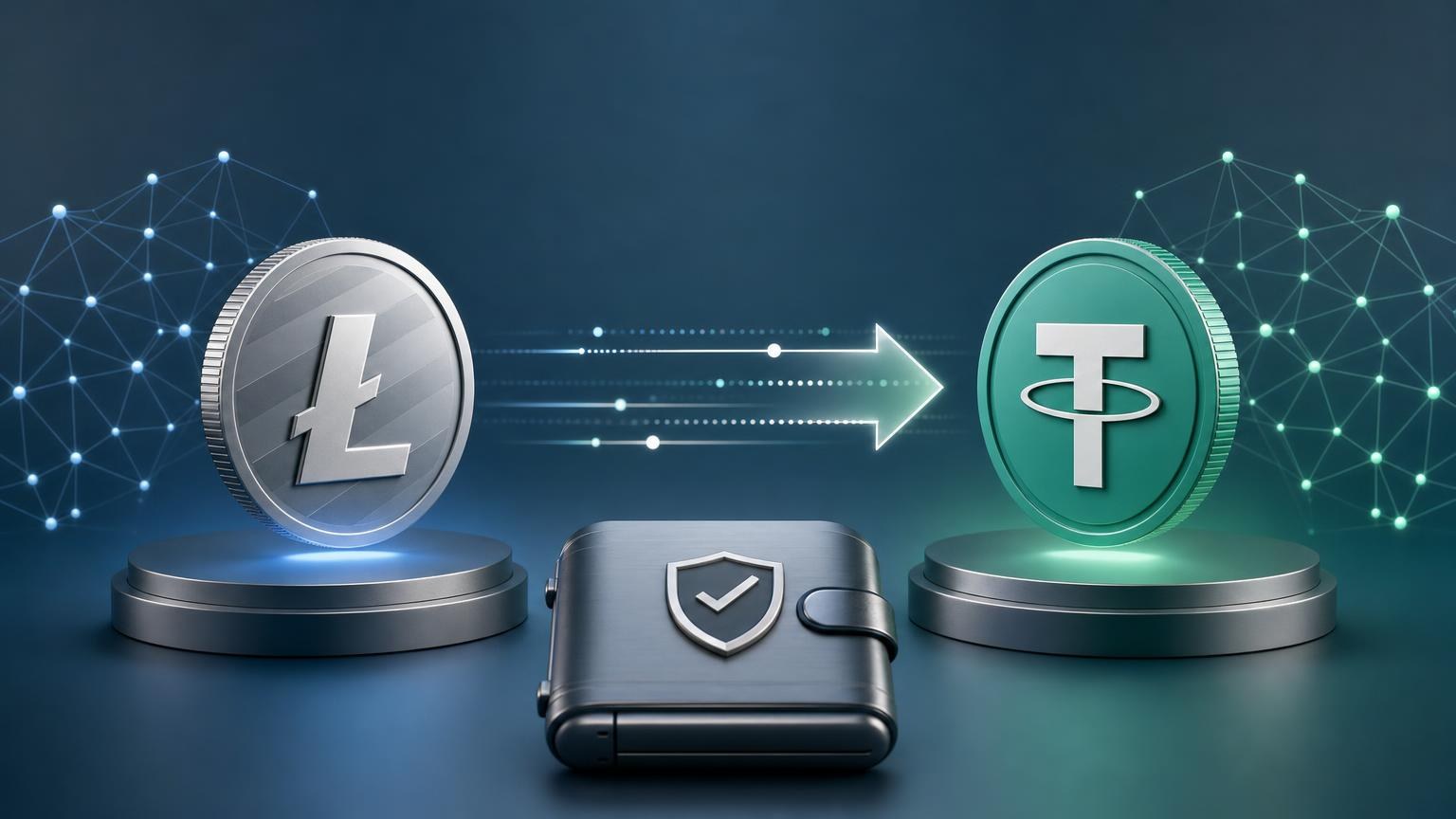
After reading this guide, you should be able to review an LTC-to-USDT order before sending funds, explain what each field means, and identify the details most likely to cause a costly mistake. You only need three concepts to begin: LTC is the asset you send, USDT is the asset you receive, and every blockchain transfer must use an address compatible with the selected network.
Think of the exchange as a journey with two separate legs. First, LTC travels from your wallet to the exchanger’s Litecoin deposit address. Then USDT travels from the exchanger to your receiving wallet on the network selected in the order. The parcel analogy helps visualize the route, but it has a limit: blockchain transfers do not come with a conventional carrier that can redirect a payment after you enter the wrong destination.
What Actually Happens During an LTC-to-USDT Exchange
An exchange begins with a quote, not with the blockchain transaction. You select LTC as the sending asset, choose USDT as the receiving asset, enter the amount, and specify a compatible USDT network if more than one option is available. USDT exists on multiple blockchains, so the network label is part of the payment details rather than a minor technical setting. [1]
The exchanger then provides instructions for the LTC deposit. Your wallet broadcasts the LTC transfer to the Litecoin network, where it must be included in the blockchain. The order may remain pending while the service waits for its required number of confirmations. Litecoin’s official materials note that recipients can choose to wait for additional confirmations depending on their acceptance policy. [2]
Once the deposit and any applicable checks have been completed, the service processes the conversion and sends USDT to the address entered in the order. LTC and USDT are supported assets, but the availability of the exact LTC-to-USDT direction and the required USDT network should be checked before creating an order. Verification requirements can also depend on the transaction direction and the outcome of compliance screening.
How Long the Exchange Can Take
There is no responsible way to give one universal completion time. “Exchange speed” combines several stages that do not always move at the same pace:
- Order preparation: the time spent selecting the assets, network, amount, and receiving address.
- LTC broadcast: the time before your wallet sends the transaction to the network.
- Blockchain inclusion: the wait until the LTC transaction enters a block.
- Confirmation policy: the number of confirmations required by the exchanger before it accepts the deposit.
- Processing and checks: conversion, operational queues, and any applicable compliance review.
- USDT payout: creation and confirmation of the outgoing transaction on the selected USDT network.
A fast first confirmation does not guarantee that the entire order will finish at the same moment. The service may require several confirmations, while the payout network has its own conditions. Check the order page for the current status instead of estimating completion from the time at which LTC left your wallet.
How to Read the Fee and Exchange Rate
The Litecoin network fee pays for broadcasting and processing your LTC transaction. It is normally shown by the sending wallet before approval, and the transaction must be included in the Litecoin blockchain to become a completed transfer. [3]
The complete exchange cost may involve more than that wallet fee. Depending on how the order is presented, the quote can also reflect an exchanger fee, a difference between the displayed conversion rate and an external market reference, or a payout-network charge. Some costs may be listed separately; others may already be reflected in the amount of USDT due to arrive.
For a practical comparison, focus on the full order summary: how much LTC leaves your wallet and how much USDT is expected at the receiving address. Read whether the quote can expire or be recalculated, and check whether the stated receiving amount is an estimate or a defined order value. Do not assume that a prominently displayed rate includes every possible charge.
Anatomy of a Hypothetical Transaction
Consider a neutral training example. A learner chooses LTC as the asset to send and USDT as the asset to receive. The order shows a Litecoin deposit instruction, asks for a USDT receiving address, and displays the applicable network, quote, fees, and expected result. No real address or amount is needed to understand the checks.
| Field | What it means and where it comes from | What to compare | What an error can do |
|---|---|---|---|
| Sending asset | LTC, selected in the exchange form and held in the sending wallet. | Confirm that both the order and wallet identify the asset as Litecoin. | Sending another asset to an LTC deposit instruction can make automatic crediting impossible and may result in loss. |
| Receiving asset | USDT, selected as the desired result of the conversion. | Check the ticker and selected blockchain network together. | Choosing the wrong asset or token variant produces a result your destination wallet may not support. |
| LTC deposit address | The destination generated or displayed by the exchanger for the incoming Litecoin transfer. | Compare the address in the order with the destination pasted into your wallet. Check the beginning, end, and preferably the full string. | A changed or mistyped address can direct LTC elsewhere. Treat a broadcast transaction as irreversible rather than assuming it can be recalled. [4] |
| USDT receiving network | The blockchain on which the exchanger will send USDT. It is selected from the networks currently offered for that direction. | Compare the order’s network label with the deposit network shown by the receiving wallet or platform. | A network mismatch may prevent automatic crediting and can lead to permanent loss if the destination cannot recover the tokens. |
| USDT receiving address | An address copied from the wallet or account where the user wants to receive USDT. | Confirm that the wallet generated it for USDT on the exact network selected in the exchange order. | A wrong character, clipboard substitution, or unrelated address can send the payout to an unintended destination. |
| Memo or Tag | An additional identifier used by some platforms or transaction routes. It is relevant only when the receiving service and the exchange order explicitly require it. | Copy it from the receiving platform and compare it character by character with the order entry. | An omitted or incorrect identifier may stop a platform from assigning the deposit to the correct account, even if the address is valid. |
| Amount to send | The amount of LTC required by the order. | Check whether the wallet fee is added on top or deducted from the entered amount. The exchanger must receive the required deposit amount, subject to its stated terms. | Sending too little may delay processing, change the result, or require additional action. Sending too much should not be assumed to produce a proportionally larger payout unless the order terms say so. |
| Expected amount to receive | The USDT result displayed in the quote or order summary. | Compare it with the rate, disclosed fees, quote conditions, and any minimum receiving amount shown. | Ignoring whether the figure is estimated or fixed can create a false expectation about the final credit. |
| Rate and fee | The conversion terms shown before payment, including any separately disclosed charge. | Read the complete summary and note any validity period or recalculation rule. | Looking only at the headline rate can hide the difference between the quoted and final receiving amounts. |
| Status and txid | The status describes the order stage. A transaction ID, or txid, identifies a broadcast blockchain transaction. | Match the LTC txid from your wallet with the deposit shown by the service; after payout, check that the USDT txid corresponds to the chosen network and receiving address. | Confusing an order number with a txid can send you to the wrong place when checking whether funds were broadcast or confirmed. |
The Pause Before You Press Send
Before authorizing the LTC transfer, stop and describe the order in plain language. You should be able to say: “I am sending LTC over the Litecoin network to the deposit address shown in this order. I expect USDT at my own address on the selected receiving network. The send amount, estimated or defined receive amount, rate conditions, and disclosed fees match the summary.”
If a Memo or Tag appears, explain why it is needed and where it came from. If you cannot identify its source, do not guess. Return to the receiving platform and check its deposit instructions.
Also review how the address entered the form. Clipboard malware and phishing pages can replace payment details without making the change visually obvious. Open the exchange page directly through a trusted route, check the domain, compare the full destination, and never provide a seed phrase or private key to create or trace an exchange order.
After completing this training review, you can check the currently available LTC-to-USDT exchange details, including the offered receiving networks and any requirements shown before an order is created.
Common Beginner Errors: Appearance, Cause, Prevention
The Address Looks Familiar but Belongs to the Wrong Network
How it looks: the wallet accepts the pasted string, so the user assumes it is suitable. Why it happens: USDT is issued on multiple blockchains, and an address alone may not communicate the intended deposit route clearly enough. [5] What to do before sending: compare the written network name in the order with the USDT deposit network in the receiving wallet. Both must refer to the same blockchain.
The Wallet Sends Less LTC Than the Order Requires
How it looks: the entered amount appears correct, but the received deposit is smaller. Why it happens: the wallet may deduct its network fee from the amount instead of adding it separately. What to do before sending: read the wallet’s confirmation screen and distinguish the recipient amount from the total wallet debit.
The Order Expires While Payment Is Being Prepared
How it looks: the user copies old deposit details or sends funds after the quote conditions have changed. Why it happens: an order was opened too early, left in another tab, or interrupted during address checks. What to do before sending: confirm that the order is still active and read the displayed rules for expired or late deposits. Do not assume a previous quote remains valid.
The Status Is Mistaken for Final Completion
How it looks: an LTC transaction appears in the wallet, but no USDT has arrived. Why it happens: “broadcast,” “confirmed,” “deposit received,” “processing,” and “payout sent” describe different stages. What to do before sending: learn which status belongs to the incoming LTC transfer and which belongs to the outgoing USDT payment. After sending, use the relevant txid rather than relying only on a wallet notification.
A Memo or Tag Is Added Without Evidence
How it looks: the user enters an account number or random note because the field is visible. Why it happens: optional and required identifiers are confused. What to do before sending: use a Memo or Tag only when the receiving platform supplies one and the selected route requires it. Never improvise this value.
A First Independent Check
- Select LTC as the sending asset and USDT as the receiving asset.
- Verify that the exact exchange direction and desired USDT network are currently available.
- Copy the USDT address from the receiving wallet’s deposit screen, not from an old message or transaction history.
- Match the receiving wallet’s network with the network selected in the order.
- Add a Memo or Tag only if the destination instructions explicitly provide and require one.
- Review the LTC amount, wallet network fee, quoted USDT result, rate conditions, and every disclosed charge.
- Copy the LTC deposit address from the active order and compare it again after pasting it into the wallet.
- Check the current verification and compliance requirements before committing funds.
- After broadcast, save the order reference and LTC txid without sharing private keys or seed phrases.
- Track the deposit, processing stage, payout, and USDT txid as separate events.
This checklist cannot remove blockchain, market, operational, phishing, or regulatory risk. It does create a disciplined pause before an action that may be irreversible—and that pause is the most useful habit a first-time exchanger can build.
